
All Guns Blazing
Combat leaves the arena and enters the sector. Your crew ships fight where everyone can see them. NPCs approach before they attack. Battle Reports record every tick. And the engine now handles 500+ entities per sector at 97% less network traffic. This is the biggest update since launch.
Combat Enters the Sector
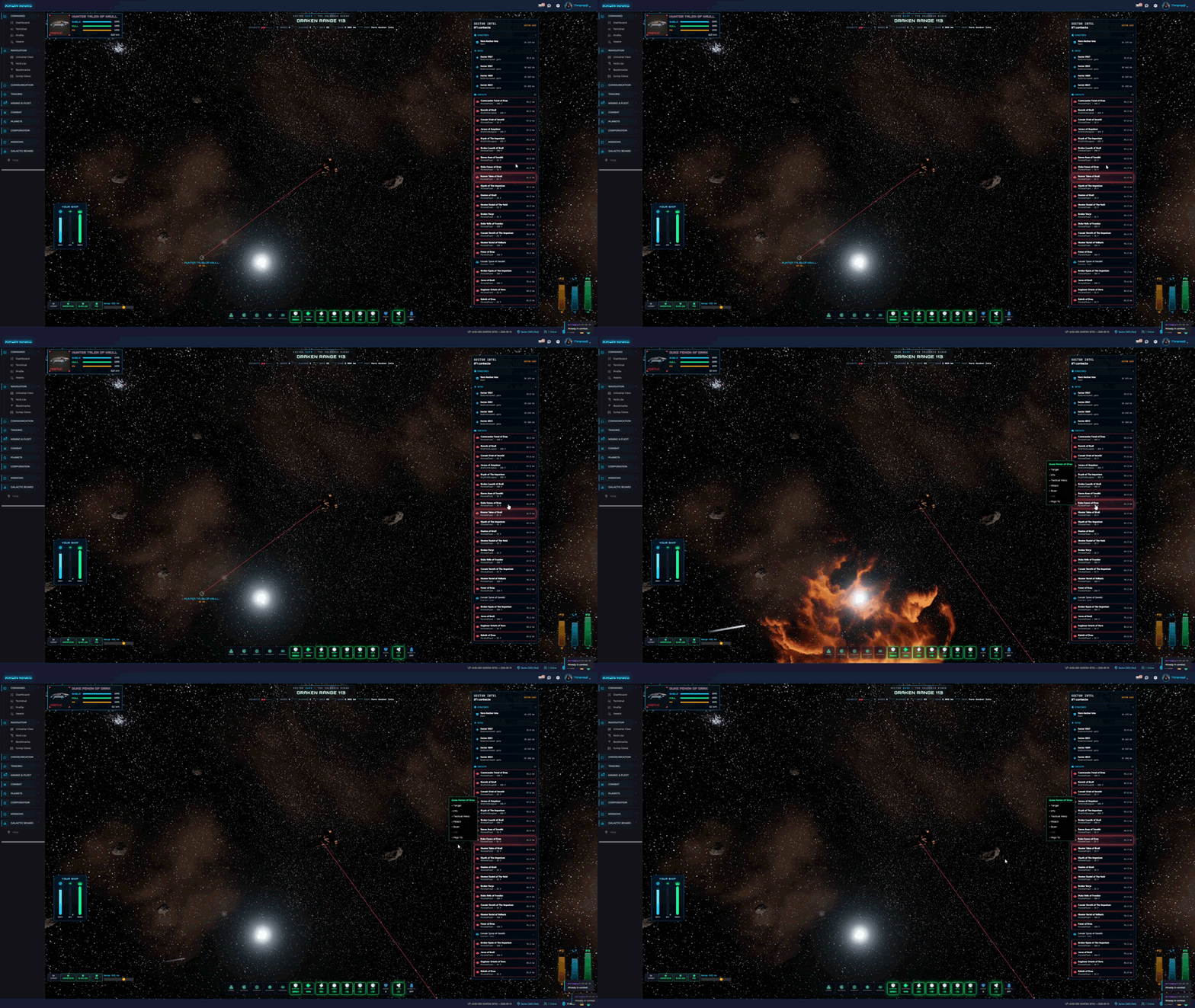
Until now, combat happened in a separate arena — a private instance where two ships settled their differences and came back. That is gone. Every fight now takes place in the shared sector, visible to every Commander in range. Your shields flash, your weapons fire, and everyone on the scanners can see it happen.
This changes the Frontier in ways that go beyond graphics. A fight near a Port is public. A fleet ambush on a trade lane leaves wreckage that other players can find. Combat is no longer something that happens behind a loading screen — it is part of the world.
Crew Ships Fight
Every crew ship in your fleet is now a full combat actor — visible in the sector viewer with its real 3D model, attackable by players and NPCs. When a crew ship is destroyed, it drops a wreck with lootable cargo, the crew member dies, and the kill is attributed to your fleet on the killboard.
Fleet Killboard
Kills and losses are tracked at the fleet level. The killboard records who destroyed what, when, and with which ship — whether the attacker was a Commander, a crew Pilot, or an NPC. Crew kills count toward your fleet’s combat record.
Smarter Enemies, Sharper Rules
NPCs no longer teleport into weapons range and open fire. They approach first — you see them coming on your scanner, watch the distance close, and have time to decide: fight, flee, or call for backup. The Frontier rewards awareness.
No one engages what they cannot see. If a target is outside your radar range, you cannot attack it. This applies to NPCs and players equally — radar upgrades are now a tactical advantage, not a convenience.
Every ship arriving in a sector gets 5 seconds of cloak. Time to assess the situation, check your scanner, and decide before anyone can lock you. Warping into a hostile sector is no longer instant death.
A new defensive module that deploys fighter squadrons automatically when your ship is attacked. The fighters engage the aggressor while you decide your next move — run, retaliate, or hold position.
When NPCs attack your crew ships, the combat is now visible in the 3D sector view — weapon fire, shield impacts, and explosions rendered in real time. No more silent deaths in a log.
Pilot Engagement Doctrine
Your Pilot is no longer a passive navigator. Through the Fleet Command panel, Commanders configure exactly how their Pilot behaves in combat — stance, range, and who to shoot.
Aggressive or Evasive — choose how your Pilot engages threats.
Set the distance in kilometers at which your Pilot opens fire.
Lawful targets, Outlaw targets, or All — filter who your Pilot will engage.
Safety locks prevent Pilots from firing on the owner, the owner’s other ships, corp mates, or active truces.
Combat v2.5 — Damage Rebuilt
The damage model has been rebuilt from scratch. Ships now have hull hardness that reduces incoming kinetic damage — heavier hulls shrug off small arms fire. Weapons fire visible beams instead of instant-hit calculations. And every ship can mount up to 48 guns across its hardpoints.
Shields and fighters are now separate equip slots with independent mechanics. Shields absorb energy damage; fighters intercept incoming projectiles and engage hostiles autonomously. Building for one does not mean neglecting the other — the best fits balance both.
Every hull class now has a hardness value that flat-reduces kinetic damage per hit. A corvette’s autocannons barely scratch a battleship’s plating. To crack heavy armor, you need heavy guns — or enough fighters to overwhelm the point defense.
Battle Reports
Every fight is recorded. Battle Reports give Commanders a personal combat history page with tick-by-tick analysis — distance over time, the moment shields dropped to zero, and damage breakdown per weapon system: fighters, point defense, named weapons. Reports cover PvP, PvE, and NPC attacks on your crew ships.
DAYS RETAINED
MAX PER COMMANDER
ONLY YOU SEE YOURS
Navigation & Physics
Ships move differently now. A new orbital motion engine gives every entity in the sector smooth, physically grounded movement — no more position snapping or jittery warps. When your ship approaches a target, it follows a predictive flight plan that curves toward the destination instead of flying in a straight line and stopping dead.
Planets, stations, and orbital debris now follow computed trajectories. The sector feels like a place that moves on its own, not a static backdrop with sprites.
Ships and asteroids have physical collision. Fly into a rock and you bounce off with knockback force — shields absorb part of the impact, but raw hull hits go straight to your structure.
Fleets no longer teleport between sectors. Every crew ship physically travels the route — you can see them in transit, track their position, and they can be intercepted along the way.
The Sector at Scale
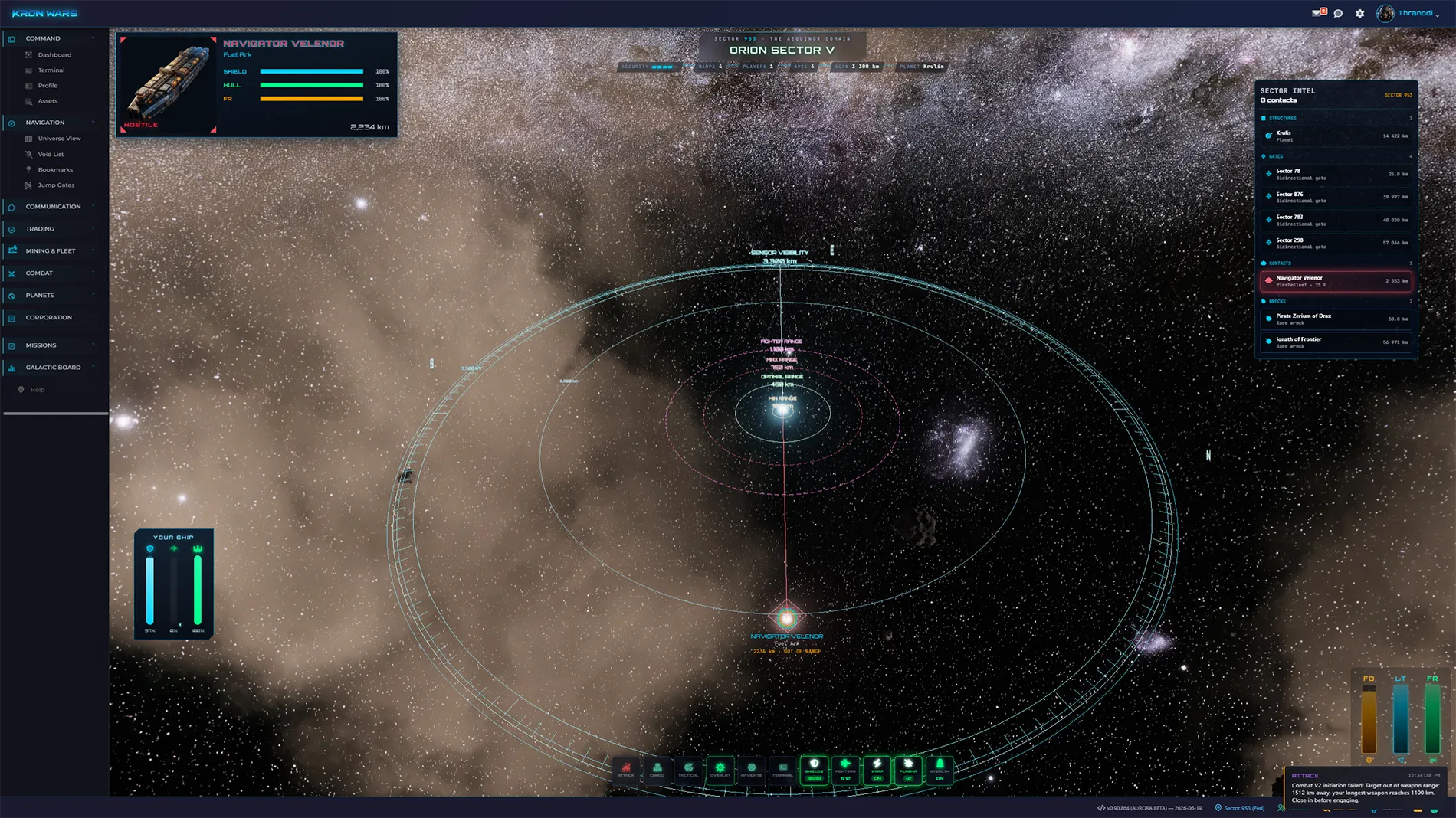
Putting combat in the shared sector means more entities on screen at once — ships, fighters, wrecks, asteroids, stations. The engine has been rebuilt to handle it.
ENTITIES PER SECTOR
Smooth rendering at scale with instanced geometry.
NETWORK TRAFFIC
Compact position data format cuts bandwidth to a fraction.
AREA OF INTEREST
Server sends only nearby entities. Far-away ships don’t consume resources.
Ships now render at their actual proportional size. A corvette looks like a corvette next to a battleship — no more same-size silhouettes.
Every ship model now uses Draco mesh compression and KTX2 textures. Faster load times, less memory, same visual quality — critical for a browser game.
HUD & Tactical Overlay
With combat in the sector, Commanders need better information at a glance. The sector viewer now includes a full HUD and tactical overlays that render directly on the 3D view.
A heading compass and speed indicator at the top of the sector viewer. Always know your bearing and velocity.
A tactical circle projected around your ship showing your maximum weapons range. Know exactly when a target enters your fire envelope.
Select a target and its 3D model gets a tactical overlay — shield status, hull percentage, distance, and threat level rendered directly on the ship.
Your fleets appear as Points of Interest on the Universe View. Select any fleet from the galaxy map and jump to its sector. The fleet picker now lives in the Universe View.
Crew & Economy
Crew members are no longer abstract entries in a roster. They have ships, salaries, portrait cards, and a physical presence in the sector. The economy underneath has been unified to match.
Hire crew at StarDocks. Each crew member has a daily KRON salary that comes out of your treasury. Better Pilots cost more — the fleet economy is real.
Hover over any crew member to see their portrait, stats, assigned ship, and current location. Every member has a face and a story.
Save ship fitting configurations as named presets — 5 base slots with bonus slots from subscriptions. Load a preset and see a diff preview of what changes before applying. Export as JSON.
Each asteroid is an individual resource node with its own mineral type and yield. Lock a rock with a reservation before mining — first come, first served. No more generic “mine sector” buttons.
All mineral accounting now runs through a single system — mining, refining, cargo, market orders, and crafting recipes reference the same unified ledger. No more phantom stock or double-counted ores.
Season System
The Frontier now runs on seasons — timed competitive periods with their own progression tracks, leagues, and milestones. Two currencies drive the system: one earned through gameplay, one through the premium pass. Both unlock rewards on the same track, but the free path has a hard cap that guarantees no amount of spending can buy a gameplay advantage that playing cannot earn.
Free players can reach the same tier as paying players through gameplay alone. The cap exists on the premium currency side, not the earned side — spend can accelerate, never surpass.
Structural guardrails prevent premium purchases from granting combat stats, exclusive ships, or economic advantages that free players cannot obtain. Cosmetics and convenience only.
Also in This Update
Commanders can now secure their account with a TOTP authenticator app. No SMS, no email codes — a proper time-based token that works offline.
NPCs now carry lore-appropriate names from faction-specific name pools instead of generic identifiers. The Frontier’s inhabitants have identities.
Crew ships are physical entities in the sector — visible on scanners, rendering their actual 3D model, moving along flight paths. Your fleet exists in the world, not just in a roster.
Voucher redemption is now fully atomic — no more race conditions, no double-spending, no partial credits. One click, one transaction, guaranteed.
“We didn’t just want combat to work. We wanted you to see the guy next to you get blown up, watch his cargo spill out of the wreck, and think: that could have been me. The Frontier should feel dangerous because it is dangerous — not because a log says so.”
— ALIEN BULB STUDIOS, SEPTEMBER 2026More From The Frontier
The universe your fleet fights in, the enemies it faces, the rocks it mines, and the gates it crosses.
The Kryllith — The Oldest Enemy
The NPCs that now approach before attacking. Three formation tiers, radar-dependent visibility, and the reason your Pilot Engagement Doctrine matters.
Read More →DevLog #8 — Asteroid Fields: Beauty and Danger
The collision physics and per-rock mining system that this update builds on — how asteroids hit back and why shields matter before you even meet an enemy.
Read More →Hollowspire — The First of the Nine
The 5,000-sector universe where your fleet operates — 1,600 ports, lawful StarDocks, and the economy your crew runs on.
Read More →DevLog #9 — The Frontier Fights Back
The previous update that set the stage — the first combat foundations, early crew systems, and the engine work that made this month’s 46-feature push possible.
Read More →DevLog #6 — Stake Your Claim: Your First Outpost
The outpost and Spire Citadel system your fleet will defend — now with real crew ships patrolling the sector and a killboard tracking who tried to take it.
Read More →